“We all want progress. But progress means getting nearer to the place where you want to be. And if you have taken a wrong turning then to go forward does not get you any nearer…Going back is the quickest way on.” — C.S. Lewis
After the Congresses of Grenoble, Montreal and Volos, the 4th International Ambiances Network Congress, entitled “Ambiances, Alloaesthesia: Senses, Inventions, Worlds”, explores the renewal of forms of feeling in a world undergoing major changes. It considers how current environmental, social, technological, political and ethical shifts are likely to affect sensory worlds, their ambiances and the ways we experience them. The conference proceedings are now available for download here. Continue reading →
The following interview first appeared in French in issue 42 of the journal Rebellion.
R / You were born in the South of France and grew up in the mining region of Graissessac (Hérault). What influence has this background had on your work and on your perception of academia?
MM — Indeed, my youth in the working-class village of Graissessac has certainly had an influence on my work, and on what we might call my perception of the world. As far as my work is concerned, I’ve talked about this in several of my books (see in particular the book of interviews with Christophe Bourseiller: Qui êtes vous Michel Maffesoli, Bourin Éditeur, 2010). The working-class milieu where I grew up taught me a sense of pride in one’s work — even a certain ‘addiction’ to it. It’s this, incidentally, that leads me to be so harsh in my judgment of those I call ‘pensioners of the Republic’, all these ineffective intellectuals and so-called researchers who never actually find anything.
At the same time, the atmosphere of the mining village gave me the sense of celebration and the ‘tragic’. So for example, the festival of Saint Barbara on December 4th was a paroxysmal moment, where effervescence in all its forms expressed itself with vigour over the course of an entire week. When I wrote L’ombre de Dionysos [The Shadow of Dionysus] (1982), I was trying to demonstrate the importance of passions and collective emotions in the organisation of the social bond. These festive phenomena, in every society, are corollaries of a sense of the tragic. It’s because of our ‘embedded knowledge’ that accident, death and finitude are always present that it’s possible in these moments to experience a heightening of the senses and a desire to fully enjoy the present. Continue reading →
It’s a kind of mental laziness for which we risk paying a heavy price. A verbal tic, pervasive on both left and right, which consists in seeing ‘communitarianism’ everywhere. A foolish attitude – as if a matter would be resolved when we suppress it, artificially, by denying it – and an infantile one too, that of incantation: we repeat the words and think that by doing so we deal with the issue.
What of the facts? It was the grandeur of social organisation in modern societies that reduced everything to the unit. Erase differences. Standardise ways of being: a beautiful ideal, the Republic, One and indivisible. But – and not for the first time – we are witnessing a saturation of this unitary ideal. Heterogeneity is regaining force and vitality; reassertion of difference, diverse localisms, linguistic and ideological specificities forming around a common origin, real or mythical. All accentuate forms of life founded less in universal reason than in shared sentiment. Continue reading →
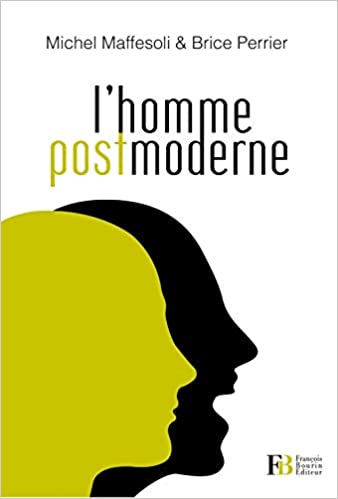
For forty years we have spoken of ‘postmodernity’. But who has really grasped the implications this holds for us as individuals? Who has equated it with the emergence of a fundamentally different human being? Relativising reason according to feeling and emotion, relinquishing his status as ‘individual’ to make way for a pluralistic nature, neglecting his civic duty to devote more time to his tribe, the postmodern man abandons almost everything his predecessor held dear.
Journalist Brice Perrier asked Michel Maffesoli and his team of researchers to create a portrait of this new human being to help us think beyond the now outdated intellectual mindsets of modernity. The result: L’Homme Postmoderne. With contributions from CeaQ researchers Émilie Coutant, Aurélien Fouillet, Stéphane Hugon, Philippe Joron, Raphaël Josset, Anthony Mahé, Thierry Mathé, Yves Mirande, Gaspard Nuiter, Olivier Sirost, Hélène Strohl, and Secessio editors Fabio La Rocca and Vincenzo Susca, this book maps out the landscape of the contemporary social world, helping up to understand who we are now. Francophone readers can download the introductory chapter in PDF form here.
 The following interview first appeared in French in issue 42 of the journal Rebellion.
 For forty years we have spoken of ‘postmodernity’. But who has really grasped the implications this holds for us as individuals? Who has equated it with the emergence of a fundamentally different human being? Relativising reason according to feeling and emotion, relinquishing his status as ‘individual’ to make way for a pluralistic nature, neglecting his civic duty to devote more time to his tribe, the postmodern man abandons almost everything his predecessor held dear.
 Secessio