by James Smith Harris
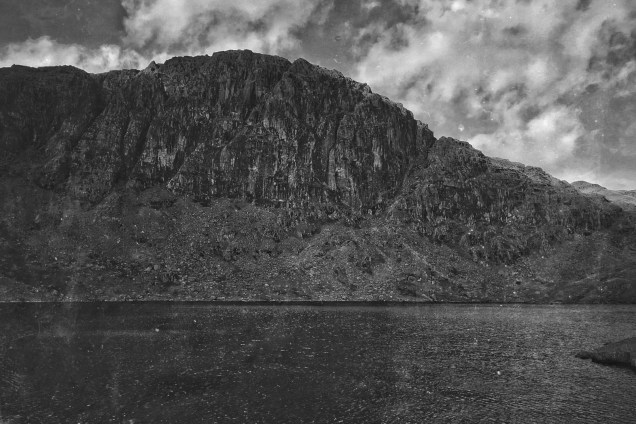
From down in the valley, Pavey Ark doesn’t have an immediately obvious role in the drama of Langdale’s towering battlements. In the jagged arrangement of peaks and crags cutting out into the mist, it sits back, a sullen wall of black stone sunk obliquely into the mountainside high above the dale. From below, it’s more a presence than a peak, standing over its neighbourhood with a quietly threatening demeanour of dignity and calm. Up close, when it slides into view over the crest of the hike from the valley floor, its effect is breathtaking.
A quarter of a mile across and some seven hundred feet in height, the face of the precipice rising from the north shore of Stickle Tarn forms the back wall of an immense natural amphitheatre. Lodged in the slopes of Harrison Stickle to the west and tapering down to nothing at its eastern shoulder, it appears on first sight as a giant, stegosaurid ridge, slashed top to bottom with deep, yawning gullies and embroidered with grassy terraces and vegetation, its rocky spine saw-toothed against the sky and massive, cracked black slabs hanging still and silent over the lake. So flawless is the configuration of mountain, tarn and crag that it’s almost as though the whole arrangement has emerged from the imagination of a Romantic painter – an impression somehow reinforced by the stone barrage that dams the southern shore of the tarn, doubling as a viewing platform from which to take in the grandeur of the composition.
This masterpiece of geology was a playground for the pioneers of British alpinism who flocked to the north of England in the late 19th century. Walter Parry Haskett Smith, the ‘father of rock climbing’, visited in 1882 on one of his first trips to the Lakes; Owen Glynne Jones, Cecil Slingsby, Norman Collie, Aleister Crowley and the Abraham brothers would all put their mark on it, as would more or less every luminary of twentieth century British rock climbing. Successive generations have bequeathed their own legacies to the rock in the invisible lattice of climbing routes that snake around its giant slabs and gullies. The stories they inscribe into its fictive inscape keep the mountain’s past quietly present in the jagged lyricism of the stone: some disingenuously picturesque (Little Gully, Gwynne’s Chimney), others openly malevolent in the chthonian toponymy favoured by the type of people whose accomplishments they weave into the philological contours of the land: Crescent Slabs, Arcturus, Fallen Angel, Cruel Sister, Mother Courage, Rainmaker, Impact Day, and a long list of others that would look as at home on an Iron Maiden setlist as in any climbing logbook.
For most visitors, the calls of the climbers echoing around the cirque are just one of a million brush strokes that make up the spectacular vista that bursts upon the senses at the end of the climb from the valley floor. But while the poetry of their route names might go unnoticed except by those for whom it provides the reference system of their sport, the name of the mountain itself, of course, rarely does. ‘Ark’ seems like an unusual toponym in these parts, yet even without knowing anything of its provenance it somehow feels strangely appropriate: a vessel of secrets, sacred things, unknowable; ‘arcane’ – as if a statement of the mystery the human animal ascribes to these great natural monuments that have stood in place since the planet was in its fiery infancy.
For many years the name was thought to derive from the Anglo-Saxon hearg, a holy grove or temple (from the Old Norse hörgr, meaning a heathen altar, a place of worship or sanctuary), and the Icelandic paufi – a “lurking fiend” (according to some sources; to others, a “dark and mysterious corner”): “Altar of the Lurking Fiend”. Current consensus puts the etymology of the term ‘Ark’ in the Old Norse element ‘erg’, a relative of the Gaelic airigh, meaning ‘shieling’ or ‘hill-pasture’. The element appears in more subtle forms (-er, -ergh, -argh etc.) in many place names of northern England, as in Mansergh, Cleator and Torver in Cumbria, Grimsargh in Lancashire and Arkengarthdale in Yorkshire. Arklid, at the south end of Coniston Water, is the hlíð (fellside) of the erg. Little Arrow near Coniston, formerly known as Little Ayrey, and Airey Force at Ullswater derive from an alternative form of the word, also found in Orkney, Shetland and the north of Scotland in Askary, Halsary and others. As for ‘Pavey’, ‘Pavia’ is now thought to have been a woman’s name (a 1902 study of the region’s Viking history notes Pavy-fields on the Solway, named after Pavia, the widow of a local landowner named Robert de Grinsdale); so, ‘Pavia’s Shieling’.
Oddly enough then, the obvious Noachian connotations aren’t actually a million miles from the most probable etymology of the name, suggesting a place of sanctuary. Put it to a vote among anyone who’s ever visited Pavey Ark on a rainy day in winter though, and I’d hope that ‘Altar of the Lurking Fiend’ would be a stronger contender. For while the cavernous topography of this remote corrie tarn no doubt provides shelter from the arctic winds sweeping down over the fells, the primeval giant rising from its northern shore looks anything but beneficent, especially through the murk of the crepuscular months when the mountain’s summit is shrouded in cloud and the specks of primary colour against the gunmetal grey are few and far between.
 Secessio